Phakic Lens Implants (ICL)
For the correction of high near- and farsightedness
Phakic Lenses at a Glance
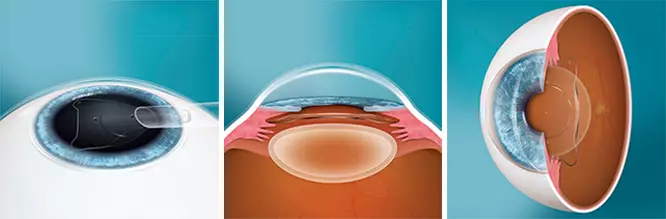
- A phakic lens is an additional synthetic lens that is implanted into the eye to correct the existing refractive error.
- Phakic lenses are used to correct moderate and severe refractive errors, such as nearsightedness from ca. -6 to -23 dpt and farsightedness from ca. +3 to + 12 dpt.
- In combination with a Femto-LASIK, severe refractive errors and an accompanying astigmatism can be corrected as well
- Phakic lenses are implanted in addition to the natural lens.
- Phakic intraocular lens implants are known for the high potential of exact predictability, the reproducibility of the surgical success and the reversibility of the procedure.
- By implanting a phakic lens, the center of the cornea remains untouched and the anatomy of the eye is not modified.
Dr Jørgensen explains: How ICL can correct mypopia
Course of the procedure
Phakic lenses are implanted into the eye in addition to the eye's natural lens.
A small incision (approximately 3 – 5 mm) is placed at the periphery of the cornea. Some lenses are flexible and therefore foldable, which reduces the incision needed to 3.2 mm.
Depending on the type of phakic lens, two positions within the eye are possible: Some lenses such as the Artiflex or Verisyse phakic lenses are placed into the anterior eye chamber and secured into place on the iris. Other lenses, such as the ICL, are placed into the posterior eye chamber behind the iris and in front of the natural lens.
Who is a candidate for a phakic lens implant?
Phakic lenses are mainly used for correction of moderate to severe nearsightedness and farsightedness. Younger patients, who do not yet need reading glasses, generally receive a synthetic lens implant while keeping their eye's natural lens. For older patients, it is usually better to exchange the eye's natural lens with a synthetic lens of the appropriate prescription.
Besides the severity of the refractive error, the diameter of the pupil when dilated in darkness, the thickness of the cornea as well as some other parameters must be taken into consideration. These parameters are assessed at your initial eye exam at our FreeVis LASIK Center. In a detailed consultation with you, we will discuss which procedure best suits your needs.
Please note:
Generally, patients with chronic and progressive disorders of the eye, such as glaucoma and certain retinal disorders as well as patients younger than 18 years old, should not receive a phakic lens implant.
Is an enhancement procedure possible?
Yes. Generally, the implant of a synthetic lens reduces the refractive error significantly. However, total freedom from wearing eyeglasses cannot be achieved in all cases. If a refractive error remains after a phakic lens implant, it can be corrected with an additional laser surgery, also known as LASIK.
Which problems can occur with synthetic lenses?
When the pupil is dilated at dawn and at dusk, the refraction of rays of light at the edge of the synthetic lens can lead to an increase in glare. Additionally, long-term results dating back numerous years are not yet available for some of the newer and more modern synthetic lenses. Finally, the procedure involves a surgery in the inner eye, meaning that in extremely rare cases severe side effects are possible.
What can you do to see well with phakic lenses?
- Do not rub on your eyes for the first few days after surgery!
- Apply the eye drops regularly as prescribed by your physician; only use the eye drops for the amount of time specified by your physician; extended use of this powerful medication may be harmful to your eyes.
- Keep appointments for your postoperative eye exams.
- Schedule a checkup once a year so that possible long-term effects can be detected early.
- Contact your physician immediately if you experience severe pain or a sudden decrease in vision.
Treatment costs
The treatment costs for vision correction surgery are generally not reimbursed by the statutory health insurance. This also applies to the initial (pre-op) consultation and follow up exams after the procedure. The treatment is billed according to the doctor's fee schedule (GOÄ).
Click here for an approximate cost overview.