Femto-LASIK with the Femto Second Laser (Laser-LASIK): What is it, what are the advantages?


With Femto-LASIK only lasers are used (thus the term “Laser-LASIK”).

The new procedure therefore eliminates the use of any mechanical instruments (Microkeratome), which up to now were needed to prepare the corneal flap.

1. Why using a laser instead of the microkeratome?
Rare complications in standard LASIK procedures (“button-holes”, incomplete or severed flaps) could almost always be traced to the preparation of the corneal flap. It was therefore obvious to further develop the procedure, and to optimize the preparation of the corneal flap.


2. How does the femto second laser work?

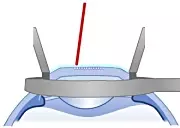
The femto second laser that is being used in Femto-LASIK instead of the microkeratome sends ultra-short light pulses with several 100 femto-seconds (1 fs = a millionth of a billionth second). By accurately focusing the laser beam, very high energy densities can temporarily be achieved in the interior of the cornea. The effect of the photo disruption only occurs in the focal point, i.e. the tissue is severed. Outside the defined area, the tissue remains the same. A complete cut in a level is achieved by placing thousands of these laser pulses next to each other. The cornea lid, thus created, can be lifted up with a precision instrument.


3. How does Femto-LASIK work?

The femto second laser is only used for the first part of the LASIK surgery, namely to prepare the corneal flap. For the actual cornea ablation, resulting in the correction of the visual disorder, the excimer laser is still being used as before.

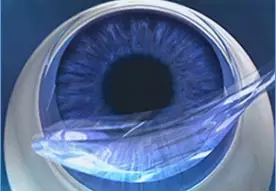
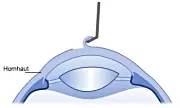
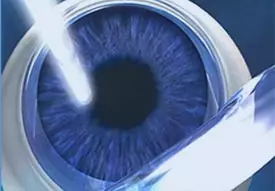
To begin with, the femto second laser prepares the corneal flaps (1.) on both eyes on the patient while lying down. Following after, the surgery table is moved under the Excimer laser to perform the second part of the LASIK surgery. The flap is opened like a page of a book (2.) and the excimer laser is used for the corneal ablation to correct the visual disorder (3).

The Femto-LASIK (animation)
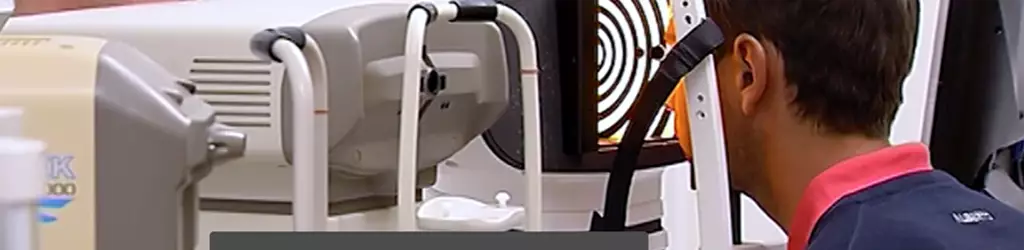
Take a look through the OR microscope...

QuicktimeQuickTime downloaden
Broadband (medium quality)
Broadband (high Quality)

Windows Media Windows Media Player downloaden
Broadband (medium quality)
Broadband (high quality)

Highest quality, MPEG (14 MB)

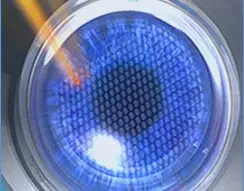
Watch the first step of a Femto-LASIK procedure life and in realtime!
The corneal flap is cut with the femtosecond laser and lifted up like a book cover...

QuicktimeQuickTime downloaden
Broadband (medium quality)
Broadband (high quality)

Windows Media Player downloaden Windows Media
Broadband (medium quality)
Broadband (high quality)


Highest quality, MPEG


4. What advantages are offered with Femto-LASIK?
The computer controlled femto second laser is used to cut level, parallel cornea segments, i.e. the corneal flap in the center has the exact same thickness as in the periphery. This gives the entire flap more stability, it can be folded back and forth much easier and it attaches smoothly. Folds in the flap (Microstriae) are practically unknown.


Cut complications such as “button-hole”, incomplete or severed flaps are also being eliminated. Initial study results even suggest that with the femto second laser, the thickness of the LASIK flaps can even be defined more accurately than with the conventional microkeratome.


5. Where is Femto-LASIK being offered?

The femto second laser is currently being introduced in Europe. In the US, this new technology has been used already in over 100,000 procedures.
FreeVis offers Femto-LASIK in the FreeVis Centres in Fürth, Lohr a. Main, Mannheim, München, Basel, Bern and Zurich.